The Ilizarov tension–stress principle
Living tissue can respond to gradual, controlled tension. Ilizarov’s work on bone reconstruction explored how a stable frame and carefully planned movement can support tissue formation. Today, researchers are investigating how transverse bone transport may affect circulation in the lower limb.
From a foundational principle to new approaches
- 1989 · Foundational research
Ilizarov published studies describing how tissue responds to tension, including the importance of stability and the rate and frequency of movement.
- 2020–2022 · TTT clinical research
A clinical guideline and a multicenter cohort examined tibial transverse transport for selected diabetic foot ulcers.
- Today · A new fibular direction
Response Ortho® is developing its patent-pending FTT method around a segment of the fibula. Its clinical outcomes need to be evaluated separately from TTT.
TTT within a plan for limb preservation
A difficult foot wound often needs coordinated care over time. TTT may be considered for selected patients as one part of that plan, alongside wound protection, infection treatment and assessment of blood flow. The treating team plans the procedure, supervises controlled bone movement and reviews recovery at each stage. The aim is to support healing while considering the limb’s function and the patient’s daily needs. The plan can change as the wound and overall health change; treatment decisions remain with the treating physician.
Why blood flow matters for your foot
Blood carries oxygen and nutrients to the tissues around a wound. When circulation is poor, healing can be harder. The smallest blood vessels help deliver that supply locally. TTT research asks whether carefully controlled bone movement can encourage small-vessel responses farther down the leg. This proposed effect is called distal microvascular regeneration. It is being studied alongside wound care, infection management and circulation assessment—not as a replacement for them.
From blood flow to tissue support
Researchers are studying whether controlled bone movement can stimulate small-vessel responses farther down the leg. The diagram explains the question; it does not show a proven treatment result.
TTT today, a new direction with FTT
Response Ortho® manufactures MicroLift®, a platform for controlled transverse transport used in TTT. TTT works with a segment of the tibia, the main load-bearing shinbone, and has published clinical experience in selected diabetic-foot patients. FTT is Response Ortho®’s newer, patent-pending approach using the fibula, the smaller bone alongside it. Its design aims to apply the transport principle at a different bone while leaving the tibial cortex outside the transport site. The fibula carries a smaller, variable share of leg loading; this offers a biomechanical rationale for investigation, not proof of fewer fractures, easier weight bearing or better healing.
Tibial Transverse Transport (TTT)
TTT uses an external fixation construct to move a surgically prepared segment of the tibia, or shinbone, in a controlled transverse direction. The surgeon plans and supervises the procedure.
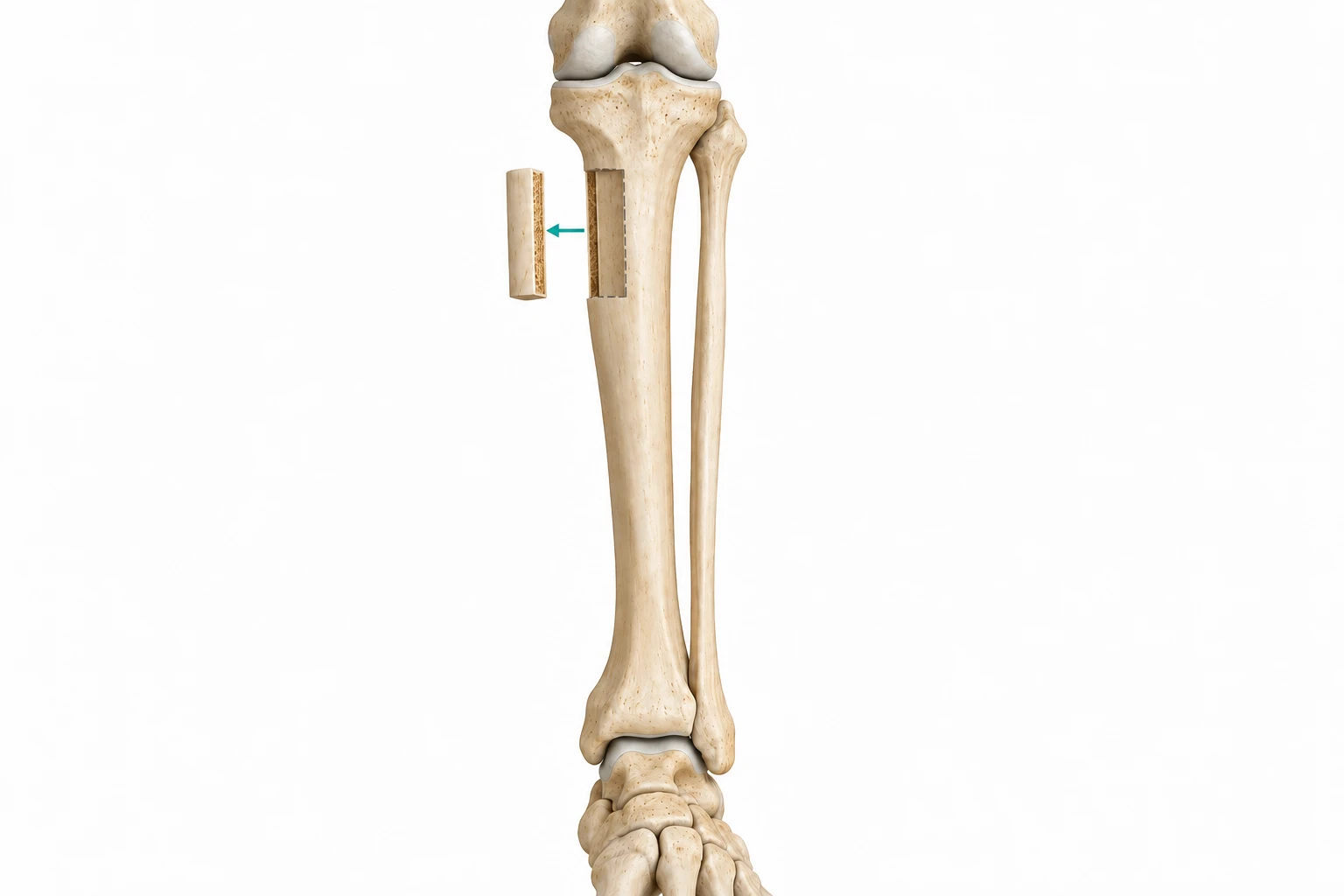
An emerging surgical approach
TTT has been investigated in selected patients with difficult-to-heal diabetic foot ulcers. Research reports must be interpreted in the context of patient selection, accompanying care, study design and follow-up.
What it is intended to support
Researchers investigate whether controlled transport can support microcirculation and wound healing. Improvements observed in a study are not a prediction for an individual patient.
Risks and treatment burden
Surgery, temporary pins and follow-up are involved. Reported complications include pin-site infection and tibial fracture. Your surgeon should explain the complete risk profile and alternatives.
What this means for your treatment
A physician weighs the available evidence, current device labeling, your circulation and the practical demands of care. MicroLift’s mechanical role, published TTT results and the potential benefits of FTT should each be considered on their own terms. Ask which approach is being proposed and what evidence supports it for your situation.
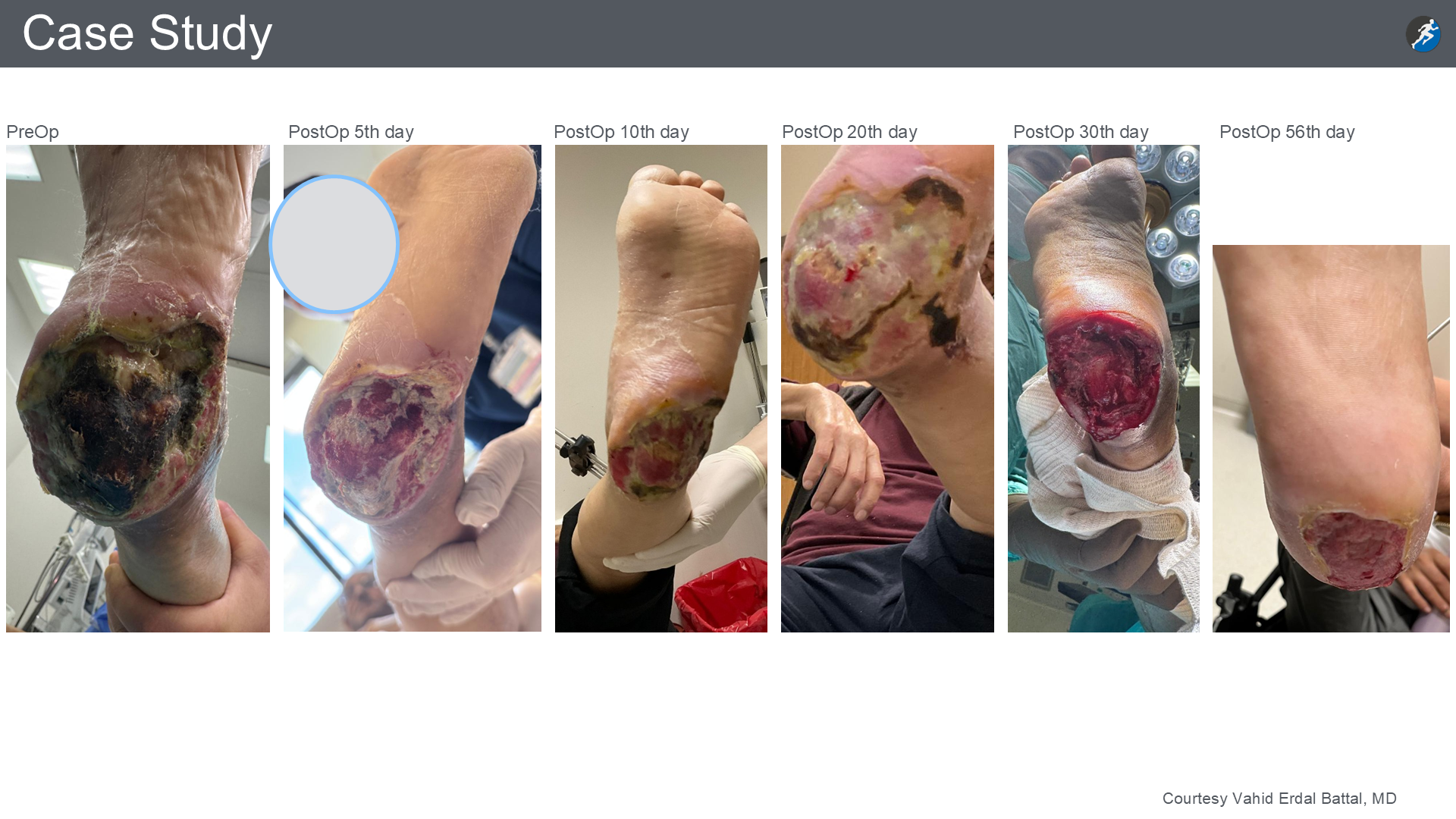
A clinical example over time
The following slide contains photographs of an open foot wound and may be uncomfortable to view. It records one case before surgery and at days 5, 10, 20, 30 and 56 afterward.
View clinical case photographs
Sources & further reading
- Diabetes & Foot Problems — NIDDK
- Ilizarov, 1989: tension–stress principle
- Ilizarov, 1989: rate and frequency of distraction
- Hua et al., 2020: CAOS clinical guideline for TTT
- Chen et al., 2022: prospective multicenter TTT cohort
- Takebe et al., 1984: Role of the fibula in weight-bearing
- MicroLift® manufacturer information
- Hu et al., 2023: systematic review of TTT
- Systematic review of TTT, 2025